
- 408-924-7560
- Email MTI
- Individual Giving
- Corporate & Foundation Giving

Learning at 200 mph: Lessons for Better Passenger Rail from France and Spain
Abstract:
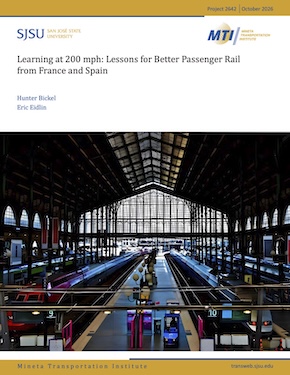
In May 2025, a group of U.S. students and professionals traveled from Paris to Madrid by high-speed rail—with intermediate stops in Strasbourg, Lyon, Valence, Barcelona, and Zaragoza—to study passenger rail systems and stations in France and Spain. Through site visits to seven cities, 19 stations, and in-depth discussions with European transportation and urban planning experts, the group examined how HSR and station design support efficient mobility, urban vitality, and successful megaproject delivery. This report synthesizes lessons from this study trip relevant to North America, with a particular focus on station planning, governance, and project execution.
Findings show that HSR is a highly competitive mode for trips of roughly 100–500 miles, offering reliable, low-stress, and city-center-to-city-center travel that rivals air and automobile modes. Well-designed stations enable seamless connections across local, regional, national, and international scales, while prioritizing pedestrians, cyclists, and transit over private vehicles. In France and Spain, stations also act as urban destinations—integrating retail, services, public space, and cultural amenities—and as catalysts for neighborhood regeneration and transit-oriented development.
This report emphasizes the importance of designing stations around their least flexible elements—location, tracks, and the station location itself. While there may be considerable uncertainty about future passenger volumes and development around a station, it is nonetheless critical to do one’s best to get these items right from the outset. Strong national institutions, centralized station management, and coordinated wayfinding and amenities create a seamless passenger experience across multiple operators. European case studies also highlight the role of governance in megaproject delivery: purpose-built delivery entities with high in-house capacity and institutional memory, along with streamlined approval processes, enable rail megaprojects to be completed more quickly and at far lower cost than comparable projects in the United States. Complementing these technical and organizational approaches, effective outreach strategies that focus on project benefits build public trust while staying true to strategic project principles.
Taken together, the lessons from France and Spain suggest that HSR can play a transformative role in U.S. mobility and urban development—but only if paired with well-located, people-centered stations; strong governance; integrated planning; and credible, efficient project delivery.
Publications:

Authors:
Hunter Bickel
Hunter Bickel is a transportation professional with experience in transit communications, planning advocacy, and rail infrastructure research. He currently works in service communications for the Metropolitan Transportation Authority in New York, where he monitors New York City Transit Subway and Bus service and supports digital engagement across the agency’s platforms.
Prior to joining the MTA, Hunter served as Communications Manager for the Effective Transit Alliance, a New York-based technical advocacy organization focused on improving public transportation planning and investment. In this role, he managed the organization’s social media accounts and developed broader communications strategies to spread ideas and grow ETA's influence.
Most of his college and early career experience is in strategic communications, with a strong foundation in research and technical writing. He holds a bachelor’s degree from the Missouri School of Journalism, where he graduated in 2023.
Eric Eidlin
Eric Eidlin is a practitioner-researcher with deep expertise in transportation, urban planning, and station-area development. He holds degrees in urban design and urban planning and began his career as a consultant before joining the Federal Transit Administration, where he worked on major transit capital projects. Since 2017, Eric has played a lead role in shaping the San José Diridon Station project, to elevate it as a world-class multimodal hub and to attract international expertise to the project.
Eric has extensive international experience, having lived, studied, and conducted research in France, Germany, and Mexico. He is bilingual in French and English and highly fluent in German. Leveraging his language skills and European planning knowledge, he received a Cities Fellowship from the German Marshall Fund, during which he interviewed leading rail professionals and published a widely cited report Making the Most of High-Speed Rail in California: Lessons from France and Germany.
Since 2018, he has taught at San José State University’s Master of Science in Transportation Management program, offering one of the only courses in the U.S. dedicated specifically to intercity and HSR planning.
With contributions from David Archuleta, Joseph Faria-Poynter, Leah Greenblat, Dakota Gross Susan Herre, Alex Kenefick, Matt Miller, Robert Munson, Desiree Rodarte, Franklin Tang, and Emily Treffert
NOTE: The views expressed are solely those of the authors and do not represent the views of the City of San Jose, San Jose State University, the New York MTA, or any of their affiliates.
Published:
October 2026
-




Contact Us
San José State University One Washington Square, San Jose, CA 95192 Phone: 408-924-7560 Email: mineta-institute@sjsu.edu

