
- 408-924-7560
- Email MTI
- Individual Giving
- Corporate & Foundation Giving

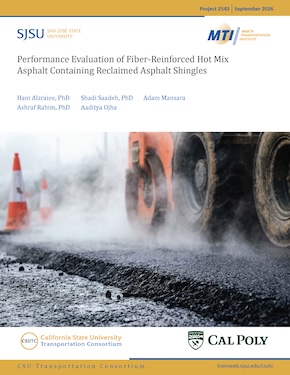
Performance Evaluation of Fiber Reinforced Hot Mix Asphalt Containing Reclaimed Asphalt Shingles
Abstract:
Reclaimed asphalt shingles (RAS) offer a promising avenue for increasing recycled content in hot mix asphalt, but the aged, stiff binder they contribute tends to reduce cracking resistance, particularly at intermediate temperatures. This study investigated whether polymer fiber reinforcement can offset that brittleness while preserving rutting and moisture performance in mixtures containing both reclaimed asphalt pavement (RAP) and RAS. Fourteen asphalt mixtures were designed using a base blend of 25% RAP combined with RAS at either 3% or 5% by total mix weight. Two commercially available polymer fiber types, designated Fiber A and Fiber B, were added at dosages of 0.05%, 0.10%, and 0.15% by total weight. All mixtures were evaluated for rutting resistance and moisture susceptibility using the Hamburg Wheel Tracking test and for intermediate-temperature cracking resistance using the IDEAL Cracking Test. Statistical comparisons were carried out using one-way ANOVA with Tukey adjusted pairwise contrasts against the control mix. Fiber addition did not compromise rutting performance and, in several cases, produced statistically significant reductions in rut depth. All mixtures satisfied the Hamburg moisture damage threshold. Cracking resistance improved substantially with fiber reinforcement, with Fiber B consistently outperforming Fiber A across both RAS levels. Statistically significant improvements in CTindex were observed most reliably at the 0.10% and 0.15% dosages of Fiber B. These results indicate that polymer fiber reinforcement can support higher recycled material usage in asphalt mixtures without sacrificing mechanical performance, offering a practical path toward more sustainable pavement design within a balanced mix design framework.
Publications:

Authors:
Hani Alzraiee, PhD, PE, PMP
Dr. Alzraiee is an Associate Professor of Construction Engineering at California Polytechnic State University. He has extensive experience in research covering infrastructure asset management, project delivery and contracting, condition assessment of transportation systems, and geospatial technologies.
Ashraf Rahim, PhD, PE
Dr. Rahim is a Professor in the Civil and Environmental Engineering at California Polytechnic State University. He has extensive experience in research dealing with pavement materials characterization, cement treated bases, and the performance of rubberized asphalt.
Shadi M. Saadeh, PhD, PE, M. ASCE
Dr. Saadeh is a Professor of Civil Engineering at the California State University, Long Beach (CSULB). He is also the director of National Center for Transportation, Green Technologies and Education. He has extensive experience in research dealing with pavement materials characterization.
Aaditya Ojha, EIT
Aaditya Ojha is a Graduate Research Assistant in CSULB where he is pursuing an M.S. in Civil Engineering with a transportation focus. He brings over 5 years of field experience in highway construction, underground utilities, and water infrastructure across ADB-funded programs, and he currently supports research on sustainable asphalt mix design, including performance testing of HMA mixtures containing RAP and RAS. He holds a California Engineer in Training (EIT) credential and is an ASCE member.
Adam Mansara
Adam Mansara is a graduate research assistant in Civil Engineering at California Polytechnic State University. He contributed to laboratory testing and data collection for this study, supporting Hamburg Wheel Tracking tests.
Published:
September 2026
Keywords:
hot mix asphalt (HMA)
reclaimed asphalt pavement
Polymer fiber
Hamburg tracker
Cracking tolerance index
-




Contact Us
San José State University One Washington Square, San Jose, CA 95192 Phone: 408-924-7560 Email: mineta-institute@sjsu.edu

