
- 408-924-7560
- Email MTI
- Individual Giving
- Corporate & Foundation Giving

Enhancing Sustainability and Durability in Asphalt Pavements: Evaluating the Impact of Low-Carbon Sulfur Polymer Modifiers and Reclaimed Asphalt Pavement
Abstract:
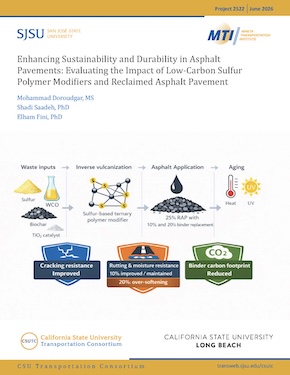
The asphalt industry faces major challenges, including the need for pavements that last longer and are more sustainable, as traditional asphalt production is costly and has a high environmental impact. To address this, researchers have been exploring modified asphalt binders such as rubber, charcoal, and waste cooking oil, which have shown promise in extending the lifespan, resistance to deformation, and durability of asphalt pavements. In addition, governments and industries are investing in the use of recycled and “green” materials to reduce the carbon footprint and environmental degradation of conventional asphalt mixtures. Building on this momentum, this study investigates the performance of a low-carbon modifier consisting of a composite of sulfur, biochar, and waste cooking oil in the conventional hot mix asphalt mixture with 25% reclaimed asphalt pavement (RAP). The modifier was introduced at 10% and 20% by the total weight of the asphalt binder, representing an asphalt mixture with 11.5% and 22.4% reduction in carbon footprint compared to typical asphalt binder, following Park et al. (2024). To understand how these lower-carbon mixtures perform in the real world, researchers used two standard tests: the Indirect Tensile Asphalt Cracking Test (IDEAL-CT) and Hamburg Wheel Tracking Test (HWT), which examined the fracture (cracking) and rutting resistance of the resulting mixtures, respectively. Extended thermal aging and UV aging were applied to study the effect of long-term aging on each scenario. Two types of aging are used, long-term aging following NCHRP (Report 973) and UV aging following Rajib and Fini (2020). The study results showed that introducing the low-carbon modifier led to less reduction in resistance to aging as measured by fracture resistance and rutting durability compared to the control scenario. This means that they maintained stronger resistance to cracking and rutting even after aging while also reducing the carbon footprint of the mixture by up to 22.4%. This research demonstrates that meaningful reductions in the carbon footprint of asphalt pavements can be achieved without compromising long-term structural performance or durability, supporting more sustainable and resilient transportation infrastructure.

Authors:
Mohammad Doroudgar
Mohammad Doroudgar recently earned his master’s degree in civil engineering from California State University, Long Beach (CSULB), specializing in transportation, pavement, and construction engineering. His research explores sustainable asphalt materials, focusing on low-carbon sulfur polymers, reclaimed asphalt pavement (RAP), and bio-based additives to improve durability and reduce environmental impacts. He has presented his work at national conferences and gained professional experience in construction management and infrastructure projects in Southern California.
Dr. Shadi Saadeh
Dr. Shadi Saadeh joined the CSULB Civil Engineering and Construction Engineering Management Department in 2007. Dr. Saadeh worked for the Texas Transportation Institute (TTI) from 2003– 2005 and the Louisiana Transportation Research Center (LTRC) from 2006–2007. He received his BSc in civil engineering from the University of Jordan (1997), MSc in Civil Engineering from Washington State University (2002), and PhD in Civil Engineering from Texas A&M University (2005).
Dr. Saadeh’s research focuses on granular materials, including asphalt mixes and their constituents. His main areas of research are experimental characterization of highway materials, constitutive modeling of highway materials at the microstructural level, performance evaluation of highway infrastructure, flexible pavement design and analysis, and experimental characterization of highway materials using X-ray computed tomography (CT), image analysis techniques, and mechanical testing.
Dr. Elham Fini
Dr. Ellie Fini is an Associate Professor at Arizona State University, an Invention Ambassador at the American Association for the Advancement of Science, a Fulbright Scholar of Aalborg University of Denmark, a Senior Sustainability Scientist at the Global Institute of Sustainability and Innovation, and Director of the Innovation Network for Materials, Methods and Management. Her research focuses on the design, synthesis, characterization, and atomistic modeling of novel materials to promote the sustainability and health of civil infrastructure.
In addition to more than 200 scholarly publications and numerous invited talks, her research has been featured by BBC Women in STEM, Science Nation, Wired Magazine, and CNBC. She is editor of the ASCE Journal of Materials and Journal of Resources, Conservation and Recycling. She has served as the president of ASCE’s North Carolina Northern Branch and a program director of the National Science Foundation. Her achievements have been recognized via multiple awards including an NSF CAREER award, ASEE Gerald Seeley award, BEYA Emerald STEM Innovation award, NC BioTech Research Excellence award, and WTS Innovative Transportation Solution award, to name a few.
Published:
June 2026
Keywords:
Polymer asphalt
hot mix asphalt (HMA)
reclaimed asphalt pavement
Asphalt additives
Asphalt mixture
-




Contact Us
San José State University One Washington Square, San Jose, CA 95192 Phone: 408-924-7560 Email: mineta-institute@sjsu.edu

