
- 408-924-7560
- Email MTI
- Individual Giving
- Corporate & Foundation Giving

Preparing Today’s Workforce for Tomorrow’s Autonomous Transportation: Bridging Electrical and Civil Engineering Disciplines
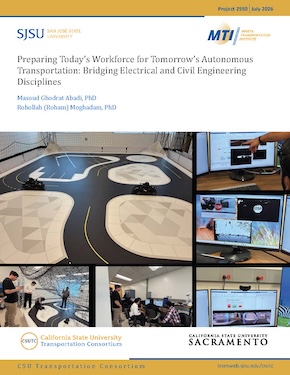
Abstract:
Autonomous vehicles (AVs) are expected to transform transportation systems and reshape workforce needs across engineering and related fields. Although existing AV workforce development efforts often emphasize electrical engineering, computer science, and mechanical engineering, transportation engineering remains underrepresented despite its importance to infrastructure, traffic operations, safety, and mobility integration. This study addresses that gap through the development, implementation, and evaluation of an interdisciplinary certificate program, Workforce for Autonomous Vehicle Engineering (WAVE), at California State University, Sacramento. The program was designed to bridge transportation engineering and electrical engineering through a two-step curriculum model consisting of theoretical educational modules and hands-on laboratory activities. Transportation engineering modules covered traffic control devices, traffic signal timing and phasing, traffic flow theory, roadway geometric design, and supplementary topics such as human factors, level of service, and intelligent transportation systems. Electrical engineering modules addressed signals and systems, sensing technologies, sensor fusion and artificial intelligence, control systems, and communication systems. The program was delivered over seven weeks to 53 civil and electrical engineering students through a customized Canvas platform and laboratory sessions using the QCar AV platform. Program effectiveness was evaluated using a three-layer framework: pre- and post-surveys, student program evaluation, and review by a panel of industry experts. Results showed substantial improvement in both student competence and confidence, strong positive student perceptions of the curriculum and laboratory experience, and strong validation from industry experts regarding the program’s interdisciplinary structure and workforce relevance. The findings demonstrate that integrating transportation engineering with electrical engineering through theory-based and experiential learning provides an effective model for preparing students for emerging careers in the AV workforce.
The educational modules and hand-on activities that accompany this report are available on this page.

Authors:
Masoud Ghodrat Abadi, PhD
Dr. Ghodrat Abadi is an Associate Professor of Transportation Engineering in the Department of Civil Engineering at California State University, Sacramento (CSUS). Dr. Abadi has over a decade of experience in engineering education and workforce development, with a background that spans multiple roles and shapes his expertise in the field. His career has included work as a traffic engineer, researcher, and professor, all contributing to his involvement in initiatives aimed at promoting and improving transportation engineering.
Rohollah Moghadam, PhD
Dr. Rohollah Moghadam is an Assistant Professor of Electrical Engineering in the Department of Electrical and Electronic Engineering at California State University, Sacramento. His research focuses on control systems, artificial intelligence, robotics, autonomous systems, and resilient control design of complex systems under cyberattacks. Dr. Moghadam received a Department of Defense (DoD) award (0012171434) in 2024 to develop an autonomous heterogeneous multiagent systems laboratory. He is also a Co-Principal Investigator (Co-PI) on a National Science Foundation (NSF) CISE award (2523881), focused on designing resilient control strategies for power systems under cyberattacks.
Published:
July 2026
Keywords:
Autonomous vehicles
Workforce development
Education and training
Interdisciplinary studies
Intelligent transportation systems (ITS)
-




Contact Us
San José State University One Washington Square, San Jose, CA 95192 Phone: 408-924-7560 Email: mineta-institute@sjsu.edu

