
- 408-924-7560
- Email MTI
- Individual Giving
- Corporate & Foundation Giving

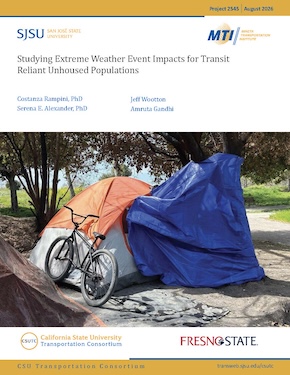
Studying Extreme Weather Event Impacts for Transit-Reliant Unhoused Populations
Abstract:
As climate change leads to more frequent and extreme weather events, people experiencing homelessness face increasing risks, including those related to mobility access. This study examines the challenges faced by unhoused individuals in Santa Clara County while accessing weather-respite services (e.g., cooling and warming centers) during extreme weather events. The research combines geospatial analysis with insights from 120 semi-structured interviews conducted with encampment residents, along with focus group discussions involving homeless service providers. Using cluster and outlier analysis (Anselin Local Moran’s I), the geospatial study identifies statistically significant areas where accessibility challenges are concentrated, revealing areas where encampments have limited access to public transit or warming or cooling centers. The qualitative findings indicate that unhoused individuals rely heavily on public transit and active transportation modes, increasing their vulnerability during extreme weather events. Access to emergency services is further constrained by transportation challenges, limited service accessibility, operational barriers, communication gaps, and other behavioral factors. The study finds that current weather respite facilities do not consistently meet the needs of the unhoused population. To address these gaps, it recommends an approach that strengthens mobility systems, expands the use of local community resources such as faith-based organizations, and enhances communication through trusted community networks. Overall, improving climate resilience for unhoused populations requires a coordinated approach that integrates transportation planning, emergency management, homelessness services, and community-based outreach.
Publications:

Authors:
Costanza Rampini
Costanza Rampini, Ph.D., is an Associate Professor of Environmental Studies in the School of Planning, Policy & Environmental Studies at San José State University. Her research focuses on the human dimensions of environmental change, specifically people’s capacity to adapt to climate change impacts and to recover from extreme events. Her work has focused on frontline communities in Northeast India and California, who are especially vulnerable to coastal and riverine flooding.
Dr. Rampini holds a Master’s and a Ph.D. in Environmental Studies from the University of California, Santa Cruz.
Serena E. Alexander
Serena E. Alexander, Ph.D., is an Associate Professor of Environmental Policy and Engineering and Interim Director of the Master of Science in Urban Planning and Policy at Northeastern University. Her research focuses on transportation decarbonization, climate resilience, freight and rail systems, and equity, with an emphasis on applied, policy-relevant research that informs planning and decision-making.
She previously served as a Visiting Scholar of Climate Policy and Infrastructure Resilience at the U.S. Department of Transportation and is a Research Associate with the Mineta Transportation Institute. Prior to joining Northeastern, Dr. Alexander was on the faculty in the Department of Urban and Regional Planning at San José State University. She has led several federally and statefunded research projects supported by USDOT, the Federal Railroad Administration, Caltrans, and the California State University Transportation Consortium.
Her work has been published in academic journals such as Cities, Transportation Research Record, and Sustainability, and she regularly engages with transportation agencies and practitioners through technical reports, workshops, and invited talks. Dr. Alexander holds a Ph.D. in Urban Studies and Public Affairs from Cleveland State University, a Master of Urban and Regional Planning from California State Polytechnic University, Pomona, and degrees in Architectural Engineering from Azad University of Tehran.
Jeff Wootton
Jeff Wootton is a Transportation Planner at Santa Cruz Metropolitan Transit District (METRO) and a graduate student at San José State University. His research interests include transportation planning, geographic information systems (GIS), urban planning, and environmental research. He has contributed to research projects in transportation and environmental studies, including geospatial analysis to support climate resilience and transit accessibility, as well as drone-based remote sensing of coastal wetlands. Wootton is pursuing a Master of Science in Geographic Information Science (GIScience) from San José State University and holds a Bachelor of Arts in Anthropology from the University of California, Santa Cruz.
Amruta Gandhi
Amruta Gandhi is a graduate student in the Master of Urban Planning program at San José State University and is currently working as a Planning Intern with the City of San Mateo. Her academic interest lies at the intersection of housing and transportation policy. Prior to pursuing graduate studies, she worked as a planner on the urban renewal program in Mumbai Metropolitan Region, India, where she also completed her Bachelor of Architecture degree.
Published:
September 2026
Keywords:
Transportation equity
Accessibility
Disasters and emergency operations
Public transit
Geospatial data
-




Contact Us
San José State University One Washington Square, San Jose, CA 95192 Phone: 408-924-7560 Email: mineta-institute@sjsu.edu

