
- 408-924-7560
- Email MTI
- Individual Giving
- Corporate & Foundation Giving

Sensing Safety: Developing a Flexible, Portable Alcohol Detection Patch for Community Wellness
Abstract:
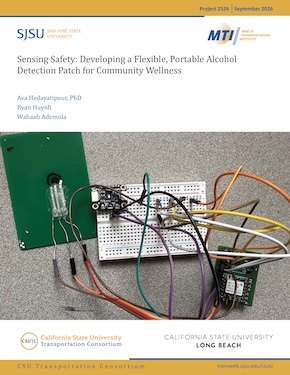
Alcohol-impaired driving remains one of the leading causes of traffic fatalities and serious injuries in the United States, posing significant challenges to transportation safety and imposing substantial social and economic costs. Although breathalyzers and wearable alcohol monitoring devices can help detect alcohol consumption, many existing technologies are expensive, bulky, or impractical for continuous, long-term monitoring. This study investigates a lowcost electrochemical sensing platform that could support future wearable alcohol monitoring systems for transportation safety applications. Specifically, the report presents the design, fabrication, and experimental evaluation of a custom screen-printed electrode (SPE) integrated with the Texas Instruments LMP91000 potentiostat. Each disposable electrode was fabricated at an estimated material cost of approximately US$0.10 and successfully detected ethanol concentrations ranging from 0% to 30% using cyclic voltammetry and chronoamperometry. Flexible carbon and silver conductive inks were used to fabricate the electrode, which was evaluated using artificial sweat solutions containing varying ethanol concentrations. Experimental results demonstrated repeatable electrochemical responses that increased systematically with ethanol concentration, validating both the fabrication approach and sensing methodology. By combining inexpensive disposable electrodes with reusable electronics, the proposed system provides a scalable foundation for future wearable alcohol monitoring technologies that could support impaired-driving prevention, workplace safety, and transportation research.
Publications:

Authors:
Dr. Ava Hedayatipour
Dr. Ava Hedayatipour is an Assistant Professor in the Department of Electrical Engineering at California State University, Long Beach (CSULB). Her research focuses on flexible and printed electronics, wearable biomedical sensors, embedded systems, point-of-care diagnostic devices, and microfabrication technologies. She leads research on the development of low-cost sensing platforms for healthcare and transportation safety applications and has authored numerous publications in wearable sensing, biosensors, and electronic systems.
Ryan Huynh
Ryan Huynh is an undergraduate student in the Department of Electrical Engineering at CSULB. His research interests include printed electronics, embedded systems, electrochemical sensing, and wearable sensor technologies. His work on this project focused on the design, fabrication, and experimental evaluation of low-cost screen-printed electrodes for wearable alcohol sensing.
Wahaab Ademola
Wahaab Ademola received his Bachelor of Science degree in Electrical Engineering from CSULB in Fall 2024. As an undergraduate researcher, he contributed to the development of flexible electrochemical sensing platforms, including printed electrode fabrication, embedded hardware integration, and experimental testing for wearable alcohol monitoring systems. His interests include embedded systems, sensor design, and biomedical instrumentation.
Published:
September 2026
Keywords:
Alcohol-impaired driving
Traffic safety
Wearable sensors
Electrochemical sensors
Biosensors
-




Contact Us
San José State University One Washington Square, San Jose, CA 95192 Phone: 408-924-7560 Email: mineta-institute@sjsu.edu

