
- 408-924-7560
- Email MTI
- Individual Giving
- Corporate & Foundation Giving

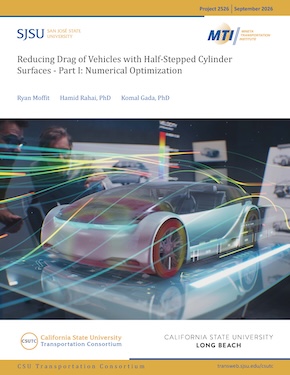
Reducing Drag of Vehicles with Half-Stepped Cylinder Surfaces Part I: Numerical Optimization
Abstract:
Aerodynamic drag is a major source of energy loss for vehicles, increasing fuel consumption, reducing the driving range of electric vehicles, and contributing to greenhouse gas emissions. For a vehicle, the major components of its drag are pressure and viscous drag. Engineers have developed a variety of strategies to reduce drag, including streamlined vehicle designs, surface modifications, and devices that alter airflow around the vehicle. This research focuses on reducing the viscous drag. Specifically, this study investigates whether microscopic surface features called half-stepped cylinder arrays can reduce skin friction by altering the turbulent boundary layer and promoting smoother airflow near the vehicle surface Using computational fluid dynamics simulations and numerical optimization, the researchers evaluated different cylinder sizes and spacing to identify a surface design that minimized skin friction on a simulated flat plate. The results indicate that when the cylinder’s dimensions are less than 1% of the boundary layer thickness, there is over 33% reduction in average skin friction. The findings demonstrate that carefully designed microscopic surface structures can substantially reduce skin friction in turbulent flows, which can contribute to improved aerodynamic efficiency and lower vehicle energy consumption. Although additional research is needed to validate these results on full-scale vehicles and under real-world operating conditions, this approach shows promise as a passive aerodynamic technology that could improve vehicle efficiency, extend electric vehicle range, and reduce transportation-related energy use and emissions.
Publications:

Authors:
Ryan Moffit
Mr. Ryan Moffit is a graduate student in the joint PhD program between California State University, Long Beach (CSULB) College of Engineering and the Claremont Graduate University (CGU) and a research assistant at the Center for Energy and Environmental Research & Services (CEERS) in the College of Engineering at CSULB. His research is focused on finding an optimized surface geometry for reducing the drag of vehicles. He has authored and co-authored two ASME conference papers and a recent presentation on reducing viscous drag of a boundary layer using a half-stepped cylinder surface at the SAE Aerotech 2026 conference in West Palm Beach, Florida.
Hamid Rahai, PhD
Dr. Hamid Rahai is a professor in the Department of Mechanical and Aerospace Engineering & Environmental Engineering and is the director of the Center for Energy and Environmental Research & Services (CEERS) in the College of Engineering at California State University, Long Beach (CSULB). He has taught various classes at the undergraduate and graduate levels in thermal sciences, supervised over 80 M.S. theses and projects and Ph.D. dissertations, and published more than 100 technical papers. He is the owner and co-owner of ten awarded and pending patents in wind energy, ambient and tailpipe NOx reductions, and aerodynamics drag reduction. He has been the principal and co-principal investigator of 72 grants and contracts from federal and state agencies and industry for over 15 million dollars. Dr. Rahai is the recipient of the 2004 Northrop Grumman Excellence in Teaching Award and the 2012 CSULB Impact Accomplishment of the Year in RSCA. He received the Outstanding Engineering Educator Award from the Orange County Engineering Council in California in 2014, and in 2019 he was inducted as a senior member of the National Academy of Inventors (NAI).
Komal Gada, PhD
Dr. Komal Gada is a senior researcher at the Center for Energy and Environmental Research & Services (CEERS) in the College of Engineering at CSULB. Dr. Gada specializes in numerical optimization and computational analyses. His research is focused on the effects of coil inserts on a pipe-jet in crossflow, vehicle drag reduction, and particle transport within confined spaces. He has authored ten journal and conference papers.
Published:
September 2026
Keywords:
Air resistance
Climate change
Aerodynamics
Drag
-




Contact Us
San José State University One Washington Square, San Jose, CA 95192 Phone: 408-924-7560 Email: mineta-institute@sjsu.edu

