
- 408-924-7560
- Email MTI
- Individual Giving
- Corporate & Foundation Giving

Steel Corrosion in Underground Transportation Infrastructure
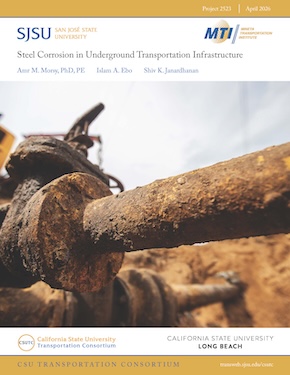
Abstract:
Corrosion of buried steel, a critical component of American transportation infrastructure, remains one of the most insidious challenges due to the uncertainty associated with its estimates. Predicting when and how this corrosion happens is very difficult. This uncertainty grows exponentially with time, making corrosion estimation in the long term even more challenging, especially with buried steel and steel structures, which cannot even be monitored visually. While significant advancement has been made to understand the effect of the various corrosion parameters on soil corrosivity, there is a lack of a comprehensive understanding of how these factors collectively contribute to corrosion as they vary simultaneously and continuously with time. This project evaluates soil resistivity and corrosivity in controlled, constant conditions, considering the various key parameters that contribute to corrosion of buried steel. The project involved devising a new experimental protocol, developing and implementing a comprehensive experimental program by varying one testing parameter at a time. The results of the testing program showed the potential of the experimental approach to provide the necessary data to develop empirical prediction models for soil resistivity. Additionally, a new experimental method was piloted for this project to capture the variation in soil resistivity in a continuously varying environment. Finally, the researchers compiled a large digital database of real-world corrosion measurements and site information. Using advanced data analysis techniques, they created a model that can help predict corrosion in buried steel structures and estimate the level of uncertainty in those predictions. Better predictions of corrosion can help engineers and infrastructure managers identify risks earlier, plan maintenance more effectively, and extend the life of critical infrastructure such as pipelines, bridges, and transportation systems, therefore helping to reduce costly failures, improve safety, and support more reliable systems.

Authors:
Amr M. Morsy, PhD, PE
Dr. Amr Morsy is a professional civil engineer with experience in both academia and industry, focusing on geotechnical engineering, transportation geotechnics, environmental geotechnics, and climate adaptation. He obtained his B.Eng. and M.Sc. degrees in civil engineering from Cairo University in 2011 and 2013, respectively, and obtained his PhD degree in civil engineering from The University of Texas at Austin in 2017. He worked as a postdoctoral fellow at The University of Texas at Austin in 2018 and as a practicing geotechnical engineer from 2018 to 2020. He later worked as a research associate at Loughborough University on the ACHILLES program grant from 2020 to 2022. He has been working as an Assistant Professor at California State University, Long Beach since 2022.
As part of his academic experience, Dr. Morsy conducts research on geotechnical infrastructure deterioration and asset management, climate change impacts on geotechnical infrastructure, and geotechnical solutions for sustainable built environments. He has excelled in physical and numerical modeling of geotechnical and geoenvironmental engineering systems, infrastructure instrumentation, and laboratory experimentation. He participated in research projects sponsored by the Transportation Research Board of the National Academies of Sciences, Engineering, and Medicine, the Engineering and Physical Sciences Research Council of the UK Research and Innovation, the US Federal Highway Administration, the Geosynthetic Institute, the Departments of Transportation of Texas and Indiana, and geosynthetic manufacturers.
As part of his professional consulting experience, Dr. Morsy conducts rigorous analyses, designs, and forensic evaluations for a range of slopes, retaining walls, reinforced soil structures, deep excavations, bridge foundations, waste containment facilities, tailings dams, and embankment dams. He assisted expert witnesses in cases involving collapse and poor performance of earth retaining structures. He provided solutions to geotechnical problems in a number of environmental remediation projects involving cleanup of superfund sites. He conducted multi-phase flow analyses for several infrastructure features, including earthworks, embankment dams, and cover systems. Some of the consulting projects he participated in served the US Environmental Protection Agency, New York State Department of Environmental Conservation, New York State and Indiana Departments of Transportation, Tennessee Valley Authority, New Jersey Transit, and several multinational private and public corporations.
Islam A. Ebo
Islam Ebo is a marine and geotechnical engineer with experience in both industry and academic research. He obtained his bachelor’s degree in civil engineering from Alexandria University in 2018 and his master’s degree in civil engineering from California State University, Long Beach.
Islam worked on a variety of large-scale civil and geotechnical engineering projects with a focus on infrastructure development, particularly in marine and coastal environments. His work involves using advanced engineering tools to ensure the structural stability and environmental sustainability of these projects.
In his research role, Islam is focused on studying soil-structure interactions, coastal protection strategies, and the effects of environmental factors on marine infrastructure. He has developed strong skills in geotechnical analysis, project management, and field assessments, working closely with multidisciplinary teams to address engineering challenges.
Shiv K. Janardhanan
Shiv Karthee Janardhanan is a second-year graduate student in Information Systems at California State University, Long Beach, with a strong interest in data analytics and predictive modeling. His academic focus is on leveraging data and information systems to support informed decision-making and solve complex technical and organizational problems.
Shiv earned his bachelor’s degree in computer science and engineering from India, where he built a solid foundation in software development, data processing, and analytical problem-solving. His graduate studies expand on this background through an emphasis on data lifecycle management, modeling, and applied analytics.
Through this research experience, Shiv has worked hands-on with complex datasets across the entire data lifecycle, from data collection and integration to cleaning, preprocessing, modeling, and evaluation, to develop predictive models for corrosion behavior. He is motivated by his goal of using data to create meaningful, positive change and to contribute solutions that improve systems, enhance sustainability, and support better engineering and organizational outcomes.
Published:
May 2026
Keywords:
Deterioration
Corrosion
Wear
Aging
Asset management
-




Contact Us
San José State University One Washington Square, San Jose, CA 95192 Phone: 408-924-7560 Email: mineta-institute@sjsu.edu

