
- 408-924-7560
- Email MTI
- Individual Giving
- Corporate & Foundation Giving

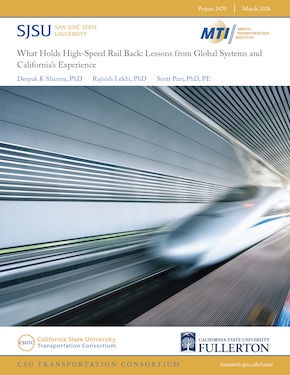
What Holds High-Speed Rail Back: Lessons from Global Systems and California’s Experience
Abstract:
This report examines benefits and challenges of integrating California High-Speed Rail (CHSR) with other rail systems and reviews California legislation impacting HSR’s contracting and financing alternatives. The research compares CHSR with high-speed rail systems around the world to identify similarities and differences in costs, speeds, ridership, and operating conditions. It also reviews Japan’s Land Readjustment Act as a model for value capture and land assembly and explores international experiences on rail integration, along with U.S. cases from the East Coast and Los Angeles. A review of California’s transportation legislation highlights how laws for highways and bridges differ from those for HSR. The study uses a database of oversight reports and legislative documents to identify recurring challenges such as funding shortfalls, permitting, cost escalation, and right-of-way acquisition. Semi-structured interviews with subject matter experts further highlight legal, financial, and project delivery issues. The study concludes that stable funding, early resolution of land and environmental issues, streamlined permitting, and better coordination across agencies are necessary for future HSR projects. Recommendations include creating stronger partnerships with third parties, adopting value capture, crowdsource financing, and reforms to eminent domain and permitting processes. This research demonstrates that effective rail integration is a governance and policy imperative critical to building a connected, sustainable, and economically competitive California.
Publications:

Authors:
Dr. Deepak K Sharma
Dr. Deepak Sharma holds a Ph.D. in Civil Engineering from the University of Maryland, College Park. He is a Professor in the Department of Civil and Environmental Engineering at California State University, Fullerton (CSUF). He has been involved with several research projects focusing on PDMs and procurement since 2007. While doing his MS, he researched the financial feasibility of P3 projects and published multiple papers. During this time, he also contributed to developing an MS Excel-based toolkit named P3 Feasibility Analysis Toolkit (P3FAST). He continued his involvement in PDMs and procurement beyond his academics and has published six high-quality journal articles, two reports, and nine conference papers. He has also presented at two TRB meetings in the area of PDMs and procurement. He also has expertise in conducting surveys and statistically analyzing data. He is an active researcher and continues researching in the area of PDMs. Before coming to CSUF, he taught Statistics and Operations Research for two years at the University of Baltimore. Lastly, as a faculty member at CSU Fullerton, he teaches several courses that touch upon project delivery methods, legal issues, quality control, cost estimation, modeling, and research.
Dr. Rajnish Lekhi
Dr. Rajnish Lekhi is an educator and researcher specializing in innovative project delivery, transportation infrastructure, and organizational leadership. With over 25 years of experience in construction, manufacturing, and international business development, he brings a unique applied perspective to large-scale infrastructure challenges. At CSUF, Dr. Lekhi serves as part-time faculty and actively contributes to research on high-speed rail systems, transit-oriented development, and value-capture models. His Doctorate in Business Administration focused on collaborative project delivery methods at Caltrans, and he is currently pursuing doctoral work in Educational Leadership to strengthen policy and workforce development frameworks. Dr. Lekhi’s interdisciplinary approach integrates engineering, data analytics, and leadership theory to inform sustainable mobility strategies. His work emphasizes resilience, equity, and innovation in advancing high-speed rail policy, with the goal of shaping efficient, inclusive, and future-ready transportation systems for California and beyond.
Dr. Scott Parr
Dr. Scott Parr, Ph.D., P.E. is a professional engineer and Associate Professor in the Department of Civil Engineering at Embry-Riddle Aeronautical University. Dr. Parr co-founded and chairs the Joint-Subcommittee for Emergency Response AMR00(1) within the Transportation Research Board. He earned his Ph.D. in Civil Engineering from Louisiana State University, specializing in Transportation Engineering and Emergency Management. Dr. Parr has published dozens of articles in peer reviewed journals and has participated as an expert panelist at conferences and workshops around the world. Dr. Parr serves as a subject area expert for several journals such as the Transportation Research Record, Journal of Emergency Management, and American Society of Civil Engineer’s Natural Hazards Review, among many others. Dr. Parr has led research collaborations with the United States Department of Transportation, Department of Homeland Security, U.S. Nuclear Regulatory Commission, and the Canadian Nuclear Safety Commission. Prior to his appointment at Embry-Riddle, Dr. Parr was an Assistant Professor in the Department of Civil and Environmental Engineering at CSUF as well as the Associate Director of Research at the Gulf Coast Center for Evacuation and Transportation Resiliency, a U.S. Department of Transportation sponsored University Transportation Center.
Published:
March 2026
Keywords:
High speed rail
Passenger rail
Rail transportation
-




Contact Us
San José State University One Washington Square, San Jose, CA 95192 Phone: 408-924-7560 Email: mineta-institute@sjsu.edu

