
- 408-924-7560
- Email MTI
- Individual Giving
- Corporate & Foundation Giving

Measuring Multimodal Equity in Resource-Challenged MPOs
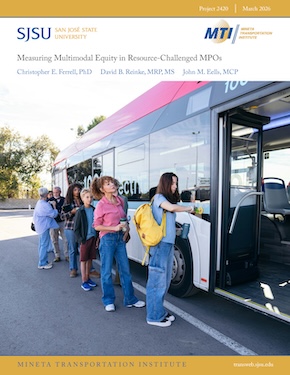
Abstract:
Ensuring transportation investments are equitable across different populations and travel modes is a priority for many agencies, yet existing tools often make these assessments difficult, especially for smaller and resource-constrained organizations. To address this gap, this report provides the findings of Phase II of our study on reviewing and developing transportation equity metrics. The Phase I project investigated transit equity metrics and provided recommendations on advancements in quantitative methods. Building on Phase I recommendations, this study investigates low-cost methods for comparing the equity between auto (roadway) and transit performance or investments for low resource transportation agencies. A literature review revealed that many metrics developed for everyday use are mode-specific, making cross-modal comparisons difficult. Others are too costly or data-heavy for smaller agencies to use. One method used in San Joaquin County, California allows for inexpensive analysis of transportation agency investments across several equity dimensions, including income, race/ethnicity, vehicle availability, and the presence of children in the household. We used these metrics and the San Joaquin method to evaluate 17 regional transportation plans from California metropolitan planning organizations (MPOs) and regional transportation planning agencies, finding that (1) transit/non-motorized spending was the most equitable in regions with large urban centers; (2) transit/non-motorized spending was often highest compared to roadway/auto spending for disadvantaged groups; (3) nondisadvantaged group spending typically favors roadway auto travel in most areas of the state; and (4) analysis is best for large urban areas using Census Public Use Microdata Sample data, but due to small sample sizes, it is often best to use Census Transportation Planning Package data instead. This project indicates that simple, low-cost approaches can produce actionable equity insights and offer a viable path for agencies that cannot employ complex or data-heavy tools, while also highlighting future opportunities to standardize and strengthen equity analyses across the state.

Authors:
Christopher Ferrell, PhD
Dr. Ferrell began his career in 1995 as a planner for the Metropolitan Transportation Commission (MTC). He completed his doctoral studies in City and Regional Planning at the University of California at Berkeley in 2005 and worked as a consultant with Dowling Associates, Inc. for 10 years before leaving to help form CFA Consultants in 2010. He is currently a principal, board member, and the executive director of Transportation Choices for Sustainable Communities Research and Policy Institute, a 501(c)(3) non-profit. He has been the principal investigator for eight research projects for the Mineta Transportation Institute, where he has been a Research Associate since 2005. His research focuses on the relationships between transportation and land use, livability, travel behavior, transportation policy, and planning-related institutional structures. His research experience includes the study of multimodal transit and freeway corridors, the best practices for building successful transit-oriented development, the effects of transit-oriented development on surrounding property values, the effects of neighborhood crimes on transportation mode choice, and a set of methods, metrics, and strategies for evaluating transit corridor livability. As a practitioner, he has planned mixed-use, infill, and transit-oriented development projects; analyzed the impacts of specific and general plans; planned and implemented intelligent transportation systems; and developed bicycle and pedestrian plans. He has taught several quantitative methods classes in San José State University’s Urban Planning Department and a course in transportation and land use in the City and Regional Planning Department at the University of California at Berkeley.
David Reinke, MS, MRP
Mr. David Reinke is a transportation engineer/economist with over 40 years of experience in travel demand modeling, transportation economics, survey design and management, database management, and software engineering. He has worked on a number of leading-edge projects in travel demand and economics, including development of activity-based travel demand models, development of discrete-choice travel forecasting models, the development of microsimulationbased models for analysis of congestion pricing alternatives, and applications of economic methods to transportation policy analysis. His areas of expertise include policy analysis, advanced statistical methods, machine learning methods, economic analysis, survey design and management, and applications of advanced computational techniques to transportation. He is currently a Research Associate with the Mineta Transportation Institute, where he has worked on studies of transit equity and transportation economics. David currently co-chairs the Education and Outreach Subcommittee for the Committee on Artificial Intelligence and Advanced Computing Applications (AED50) at the Transportation Research Board (TRB) and is a past member of TRB committees on Statistics, Economics, and Travel Behavior and Values. He is also a member of the IEEE Intelligent Transportation Systems Society.
John M. Eells, MCP
John Eells is a transportation planner with 44 years of experience preparing comprehensive transportation plans and developing sustainable transportation projects at the local and regional level. John’s experience includes two years in the Legislative Analyst Office in the California State Legislature, five years with the California Department of Transportation (Caltrans), seven years as the Transportation Planning Coordinator for Marin County, and thirty years as a consultant. He holds a Bachelor’s degree in Architecture and a Master’s degree in City Planning from the University of California at Berkeley. John has assisted in the preparation of Regional Transportation Plans for Sacramento and Lake Tahoe and reviewed Regional Transportation Plans throughout California for conformance with State greenhouse gas reduction requirements for the California Attorney General’s Office. He participated in a joint effort by Caltrans and the California Council on Science and Technology to develop a proposal for a new California Center for Transportation Innovation to coordinate transportation research activities in California. John has also managed major multi-modal transportation studies, evaluated the feasibility of proposed ferry services, and worked on the implementation of several rail transit projects including the Sacramento Light Rail project, the ACE Commuter Rail Service from Stockton to San José, the SMART Commuter Rail Service from Cloverdale to Larkspur, proposed AMTRAK service from Oakland to Reno, and the proposed high speed Maglev Service from Los Angeles to Las Vegas.
Published:
March 2026
Keywords:
Railway infrastructure
Transportation equity
Multimodal transportation
Metropolitan Planning Organizations
Census
Accessibility
-




Contact Us
San José State University One Washington Square, San Jose, CA 95192 Phone: 408-924-7560 Email: mineta-institute@sjsu.edu

