
- 408-924-7560
- Email MTI
- Individual Giving
- Corporate & Foundation Giving

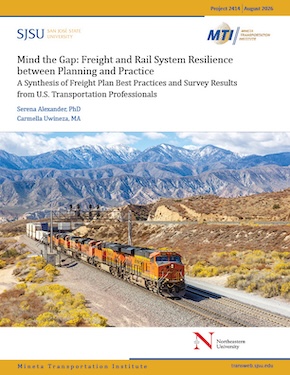
Mind the Gap: Freight and Rail System Resilience between Planning and Practice A Synthesis of Freight Plan Best Practices and Survey Results from U.S. Transportation Professionals
Abstract:
Freight and rail networks across the United States face mounting risks from weather-related hazards and other systemic disruptions that threaten operational continuity, economic stability, and community well-being. While state freight plans are federally mandated, local and metropolitan freight planning varies widely, leaving gaps in how resilience is addressed across scales. This study examines how resilience is being integrated into freight and rail planning through a two-part approach: (1) a content analysis of 43 recent state and metropolitan freight plans, and (2) a nationwide survey of 56 transportation professionals engaged in freight and rail planning. Findings show broad consensus on the importance of resilience, with shared goals around infrastructure modernization, system reliability, and emergency preparedness. However, state and local governments differ in approach: states emphasize compliance and long-term coordination, while cities and MPOs focus on community-driven innovation, mobility access, and priorities. Despite ambitious goals, survey responses reveal persistent implementation barriers, including limited funding, fragmented governance, and challenges in aligning public and private sector interests. Emerging best practices include integrating weather and hazard data into project selection, leveraging public–private partnerships, advancing multimodal connectivity, and piloting equity-centered local initiatives. The study concludes that resilience cannot remain a secondary objective—it must be embedded into core planning, evaluation, and investment processes. Recommendations include flexible federal funding mechanisms, stronger interagency and cross-sector collaboration, and targeted support for smaller and rural jurisdictions. Together, these steps can help bridge the gap between planning and practice and build a more resilient, reliable, and economically competitive freight system in the U.S.
Resilient Freight and Rail Portal Map
Explore how state and local governments across the United States are integrating resilience into freight and rail transportation planning. The interactive portal draws on the project’s review of state and metropolitan freight plans and highlights strategies related to infrastructure modernization, system reliability, emergency preparedness, multimodal connectivity, and other resilience priorities.

Authors:
Serena E. Alexander
Serena E. Alexander, Ph.D., is an Associate Professor of Environmental Policy and Engineering and Interim Director of the Master of Science in Urban Planning and Policy at Northeastern University. Her research focuses on transportation decarbonization, climate resilience, freight and rail systems, and equity, with an emphasis on applied, policy-relevant research that informs planning and decision-making.
She previously served as a Visiting Scholar of Climate Policy and Infrastructure Resilience at the U.S. Department of Transportation and is a Research Associate with the Mineta Transportation Institute. Prior to joining Northeastern, Dr. Alexander was on the faculty in the Department of Urban and Regional Planning at San José State University. She has led several federally and statefunded research projects supported by USDOT, the Federal Railroad Administration, Caltrans, and the California State University Transportation Consortium.
Her work has been published in academic journals such as Cities, Transportation Research Record, and Sustainability, and she regularly engages with transportation agencies and practitioners through technical reports, workshops, and invited talks. Dr. Alexander holds a Ph.D. in Urban Studies and Public Affairs from Cleveland State University, a Master of Urban and Regional Planning from California State Polytechnic University, Pomona, and degrees in Architectural Engineering from Azad University of Tehran.
Carmella Uwineza
Carmella Uwineza is a PhD candidate at Northeastern University’s Policy School, specializing in sustainability and resilience. She holds a BA in International Development Studies and Political Science from McGill University and an MA in Sustainable Energy Policy from Carleton University. Her research focuses on the equity and justice dimensions of climate finance, policy, and energy transitions in Africa.
Her previous research has examined Nature-based Solutions for flooding in coastal Massachusetts and federal funding for energy efficiency and heat resilience in Boston. She conducted this work with Professors Laura Kuhl and Moira Zellner, both of whom are based at the Policy School. Carmella is currently undertaking grant-funded research supported by the Climate Social Science Network on international climate finance, as well as the energy transition priorities of domestic and local actors in Kenya and Senegal.
Published:
August 2026
Keywords:
Freight and rail resilience
environmental and weather-related risks
state government
local government
policy, planning and implementation
transportation planning
freight plans
-




Contact Us
San José State University One Washington Square, San Jose, CA 95192 Phone: 408-924-7560 Email: mineta-institute@sjsu.edu

