
- 408-924-7560
- Email MTI
- Individual Giving
- Corporate & Foundation Giving

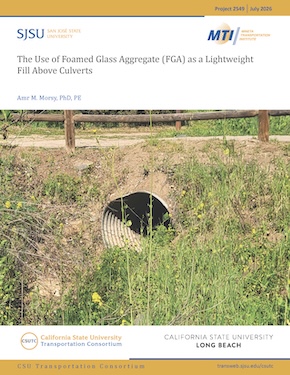
The Use of Foamed Glass Aggregate (FGA) as a Lightweight Fill Above Culverts
Abstract:
Transportation infrastructure—including buried utilities, drainage systems, and culverts—is frequently subjected to significant external stresses arising from existing conditions and new construction, especially in urban environments where deformation and failures can lead to significant operational and safety consequences. Lightweight fills offer a viable strategy to mitigate these stresses by reducing imposed loads. This study investigates the use of lightweight fills, specifically Foamed Glass Aggregate (FGA), as a sustainable solution to support California Senate Bill 1 (SB1) efforts to repair and maintain culverts, as well as for new construction applications. A numerical investigation was conducted to evaluate the performance of culverts backfilled with FGA compared to conventional fills. Models were developed for reinforced concrete box culverts and corrugated steel pipe culverts, and parametric analyses were performed across a range of configurations. Results indicate that FGA significantly reduces soil stresses, structural demand, deformation, and settlement compared to conventional fills. This study also developed design and construction guidance and proposed updates to Caltrans manuals to facilitate implementation in practice. The findings demonstrate that FGA is an effective, sustainable alternative for improving culvert performance in California and beyond, helping agencies better address aging infrastructure and increasing construction demands.
Publications:

Authors:
Amr M. Morsy, PhD, PE
Dr. Amr Morsy is a professional civil engineer with experience in both academia and industry, with a focus on geotechnical engineering, transportation geotechnics, environmental geotechnics, and climate adaptation. He obtained his B.Eng. and M.Sc. degrees in civil engineering from Cairo University in 2011 and 2013, respectively, and his PhD in civil engineering from The University of Texas at Austin in 2017. He worked as a postdoctoral fellow at The University of Texas at Austin in 2018 and as a practicing geotechnical engineer from 2018 to 2020. He later worked as a Research Associate at Loughborough University on the ACHILLES program grant from 2020 to 2022. He has been an Assistant Professor at California State University, Long Beach, since 2022.
As part of his academic experience, Dr. Morsy conducts research on geotechnical infrastructure deterioration and asset management, climate change impacts on geotechnical infrastructure, and geotechnical solutions for the sustainable built environment. He has excelled in physical and numerical modeling of geotechnical and geoenvironmental engineering systems, as well as in infrastructure instrumentation and laboratory experimentation. He participated in research projects sponsored by the Transportation Research Board of the National Academies of Sciences, Engineering, and Medicine, the Engineering and Physical Sciences Research Council of the UK Research and Innovation, the US Federal Highway Administration, the Geosynthetic Institute, Texas and Indiana Departments of Transportation, and geosynthetic manufacturers.
As part of his professional consulting experience, Dr. Morsy conducts rigorous analyses, designs, and forensic evaluations for a range of slopes, retaining walls, reinforced soil structures, deep excavations, bridge foundations, waste containment facilities, tailings dams, and embankment dams. He has assisted expert witnesses in cases involving the collapse and poor performance of earth retaining structures. He has provided solutions to geotechnical problems in a number of environmental remediation projects involving the cleanup of superfund sites. He has conducted multi-phase flow analyses for several infrastructure features, including earthworks, embankment dams, and cover systems. Some of the consulting projects he has participated in served the US Environmental Protection Agency, the New York State Department of Environmental Conservation, the New York State and Indiana Departments of Transportation, the Tennessee Valley Authority, New Jersey Transit, and several multinational private and public corporations.
Published:
August 2026
Keywords:
Backfill soils
Lightweight aggregate
Lightweight materials
Box culverts
Corrugated pipe culverts
-




Contact Us
San José State University One Washington Square, San Jose, CA 95192 Phone: 408-924-7560 Email: mineta-institute@sjsu.edu

