
- 408-924-7560
- Email MTI
- Individual Giving
- Corporate & Foundation Giving

The Future of Transit
Abstract:
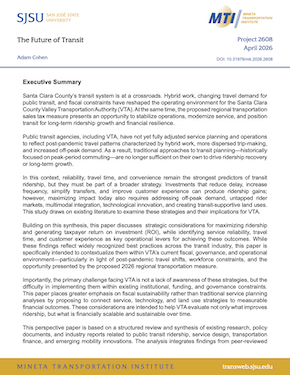
Public transit agencies are adapting to a post-pandemic operating environment characterized by hybrid work, more dispersed travel demand, workforce constraints, and persistent fiscal pressures. This perspective paper examines how transit agencies, such as the Santa Clara Valley Transportation Authority (VTA), can strengthen ridership while improving the financial sustainability and long-term resilience of its transit system. The analysis synthesizes peer-reviewed research, government and industry reports, publicly available data, transit agency case studies, and expert interviews with thought leaders. The findings indicate that reliability, travel time, frequency, and customer experience remain fundamental drivers of transit use, but that traditional peak-oriented service planning is increasingly insufficient. Strategies to address changing demand include expanding off-peak and late-night service, simplifying fares and transfers, targeting underserved and untapped rider markets, and using traveler segmentation and demand-responsive services to better match service with local needs. The paper also examines the potential opportunities and limitations of emerging technologies, including automated vehicles, microtransit, and mobility partnerships, as well as the role of transit-oriented development and real estate strategies in supporting ridership and long-term revenue generation. The paper proposes a performance and return-on-investment framework that links service quality, ridership, equity, technology, land use, and financial outcomes. The analysis suggests that transit's challenge is not identifying individual strategies, but prioritizing and implementing them within existing fiscal, institutional, workforce, and governance constraints. A coordinated approach that connects service improvements, targeted innovation, land use, and revenue generation could help transit agencies such as VTA translate future investments into measurable mobility, ridership, and long-term financial outcomes.
Publications:

Authors:
Adam Cohen
Adam Cohen is a senior researcher in innovative and emerging mobility. He has two decades of experience as a researcher with the Mineta Transportation Institute of San Jose State University and the Transportation Sustainability Research Center at the University of California, Berkeley.
Published:
August 2026
Keywords:
Attacks
Bus
Train
Transit Staff
Antisocial
-




Contact Us
San José State University One Washington Square, San Jose, CA 95192 Phone: 408-924-7560 Email: mineta-institute@sjsu.edu

