
- 408-924-7560
- Email MTI
- Individual Giving
- Corporate & Foundation Giving

SMART-TWIN: Systematic Modeling and Real-Time Transportation with Digital Twins
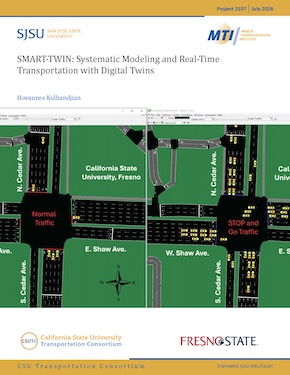
Abstract:
Urban transportation networks are increasingly affected by everyday congestion, non-recurring disruptions, and limited real-time visibility into what is happening on the road. Transportation agencies require advanced tools that support faster, proactive management and data-driven infrastructure decisions rather than passive monitoring. This report presents SMART-TWIN, an Artificial Intelligence (AI)–driven Digital Twin framework designed for real-time traffic operations, disruption detection, and performance-based decision-making support. The SMART-TWIN architecture integrates microscopic traffic simulation (detailed traffic modeling), long-horizon synthetic demand generation simulating real travel patterns, supervised machine learning, and performance analysis within a unified and reproducible workflow. A corridor-scale Digital Twin was developed for the Shaw–Cedar intersection in Fresno, California, using OpenStreetMap data and the SUMO simulation platform. An 11-year synthetic traffic dataset (2020–2030) was generated to emulate realistic traffic patterns over time and support early-stage deployment prior to full sensor availability. Supervised machine learning models were trained to classify operational conditions, including normal traffic, signal failure–induced stop-and-go conditions, and one- and two-lane closures. A Random Forest classifier achieved very high accuracy under controlled experimental conditions. To support operational decision-making, the framework translates detected traffic states into clear, measurable impacts, including estimated congestion buildup and delay-related costs using value-of-time principles. Scenario and sensitivity analyses demonstrate the compounding effects of capacity loss and control failure on congestion growth and user delay, as well as the system’s ability to detect disruptions early and reliably under moderate demand uncertainty. The results show that AI-enhanced Digital Twins can provide actionable insights into traffic conditions and operational impacts prior to full-field deployment. The proposed framework is scalable to larger corridors and networks and is designed for future integration with real-time sensor data and adaptive traffic control strategies. SMART-TWIN provides a practical foundation for next-generation Digital Twin applications that support proactive traffic management and data-driven infrastructure planning to make traveling safer and more efficient for all.
Publications:

Authors:
Hovannes Kulhandjian
Dr. Hovannes Kulhandjian is a tenured full Professor in the Department of Electrical and Computer Engineering at California State University, Fresno (Fresno State). He joined Fresno State in Fall 2015 as a tenure-track faculty member. Before that, he was an Associate Research Engineer in the Department of Electrical and Computer Engineering at Northeastern University. He received his B.S. in Electronics Engineering with high honors from the American University in Cairo (AUC) in 2008 and his M.S. and Ph.D. degrees in Electrical Engineering from the State University of New York at Buffalo in 2010 and 2014, respectively. His current research interests are in applied machine learning, autonomous vehicle navigation, wireless communications, and networking, with applications to underwater and visible light communications and networking geared towards Intelligent Transportation Systems (ITS).
Dr. Kulhandjian has received eight research grants from the Fresno State Transportation Institute (FSTI), the Claude C. Laval III Award for Commercialization of Research, Innovation, and Creativity in 2025 and 2021, and the Claude C. Laval Award for Innovative Technology and Research 2020 at Fresno State. In April 2021, as a PI, he received a grant from the Department of Defense (DOD) Research and Education Program for Historically Black Colleges and Universities and Minority- Serving Institutions (HBCU/MSIs) Equipment/Instrumentation to establish a “Secure Communications and Embedded Systems Laboratory at California State University, Fresno".
Dr. Kulhandjian is an active member of the Association for Computing Machinery (ACM) and the Institute of Electrical and Electronics Engineers (IEEE). He is a Senior Member of IEEE. He is serving as a Guest Editor for the Special Issue "Advances in Intelligent Transportation Systems (ITS)". He has served as a Guest Editor for the IEEE Access Special Section Journal, Session Co-Chair for the IEEE UComms’20 Conference, Session Chair for the ACM WUWNet’19 Conference, and Publicity Co-Chair for the IEEE BlackSeaCom Conference. He also serves as a member of the Technical Program Committee (TPC) for ACM and IEEE Conferences such as GLOBECOM 2022, WTS 2022, WD 2021, WD 2018, ICC 2018, WUWNet 2020, and WiMob2019. He is a recipient of the Outstanding Reviewer Award from ELSEVIER Ad Hoc Networks and ELSEVIER Computer Networks.
Published:
July 2026
Keywords:
Digital twin
Intelligent transportation systems (ITS)
Traffic Operations
Microscopic traffic simulation
Sumo
Machine learning
Incident detection
Traffic disruption analysis
-




Contact Us
San José State University One Washington Square, San Jose, CA 95192 Phone: 408-924-7560 Email: mineta-institute@sjsu.edu

