
- 408-924-7560
- Email MTI
- Individual Giving
- Corporate & Foundation Giving

Equitable Estimation of Accurate High Injury Networks (HINs) for Vulnerable Road Users
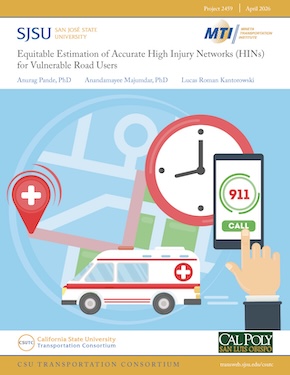
Abstract:
To improve traffic safety, communities first need to know where serious crashes are actually happening. High-Injury Networks are designed to identify these locations, but they are usually built using only police-reported crash data. This research asks: Are we missing crashes—and injuries—by relying on police data alone? The research team first demonstrates that data from Emergency Medical Services and those from official databases differ substantially, and neither data set captures the full extent of collisions in a community. Following that analysis, the research team concluded that a new data source may help complete this. Toward that end, the research team scraped data from PulsePoint in San Francisco to identify potential traffic collisions reported to 911 operators. The 911 call data for San Francisco, when compared with official city crash data sources, shows that several traffic incidents reported on 911 calls do not appear in the city’s official database. Statistical analysis of data from both sources vs. those found in only one of the two reveals patterns by location. Locations in police districts with lower population density (and larger geographical areas) had more 911 call-reported incidents that did not appear in the official database. The demographics of census tracts of the incident’s reported location, such as income, race, and education levels, did not appear to be statistically significant. Based on the findings, the research team provides a framework for complementing collision data with alternative sources beyond the police records in future Vision Zero efforts. The research project also resulted in a process that allows the team to continuously add to the scraped 911 call data, enabling this analysis to continue beyond what is presented in this report. When serious injuries are invisible in the data, they are invisible in safety planning. Integrating and using all available data is critical to ensuring that Vision Zero strategies reflect real-world injury risk and deliver meaningful, life-saving outcomes.
Publications:

Authors:
Anurag Pande, PhD
Dr. Pande is a Professor of Civil Engineering at Cal Poly. His research interests include traffic simulation, data mining applications, and observational data analysis, including in the areas of traffic safety and crashes, driver behavior, transportation resilience, and emergency evacuation. As the faculty liaison for community-based learning at Cal Poly, he has worked with Cal Poly faculty and local agencies to support projects of mutual benefit. He has co-authored close to 50 manuscripts that have been either published or are forthcoming in peer-reviewed journals. He has worked on several sponsored projects, including a study on driver behavior funded by the National Science Foundation. He was the editor of the 7th edition of the Traffic Engineering Handbook (TEH), published by ITE (Institute of Transportation Engineers). Dr. Pande received his B.Tech. in Civil Engineering from the Indian Institute of Technology Bombay in Mumbai (India) and his MS and Ph.D. in Civil Engineering from the University of Central Florida (UCF).
Anandamayee Majumdar, PhD
Dr. Majumdar is an Assistant Professor of Statistics at San Francisco State University. Her research interests include spatial and temporal modeling and simulation, with applications to geographically referenced data, and observational data analysis. She uses and develops data analytical tools in her research and software packages in open source. Part of her research has focused on data exploration and model validation as well as spatial kriging for missing data. She was co-PI to a “highlighted project” by the National Science Foundation in 2006–2009. She has co-authored more than 40 manuscripts that have been either published or are forthcoming in peerreviewed journals. Dr. Majumdar received her B.Stat. and M.Stat. in Statistics from the Indian Statistical Institute in Kolkata (India), her MS in Statistics from Michigan State University, and a Ph.D. in Statistics from the University of Connecticut (UConn).
Lucas Roman Kantorowski
Mr. Kantorowski is a Master's student in Statistics at Cal Poly. He received his Bachelor’s degree in Applied Mathematics from Cal Poly San Luis Obispo in 2024.
Published:
April 2026
Keywords:
Transportation safety
Crash data
Vulnerable road users
Demographics
Spatial analysis
-




Contact Us
San José State University One Washington Square, San Jose, CA 95192 Phone: 408-924-7560 Email: mineta-institute@sjsu.edu

